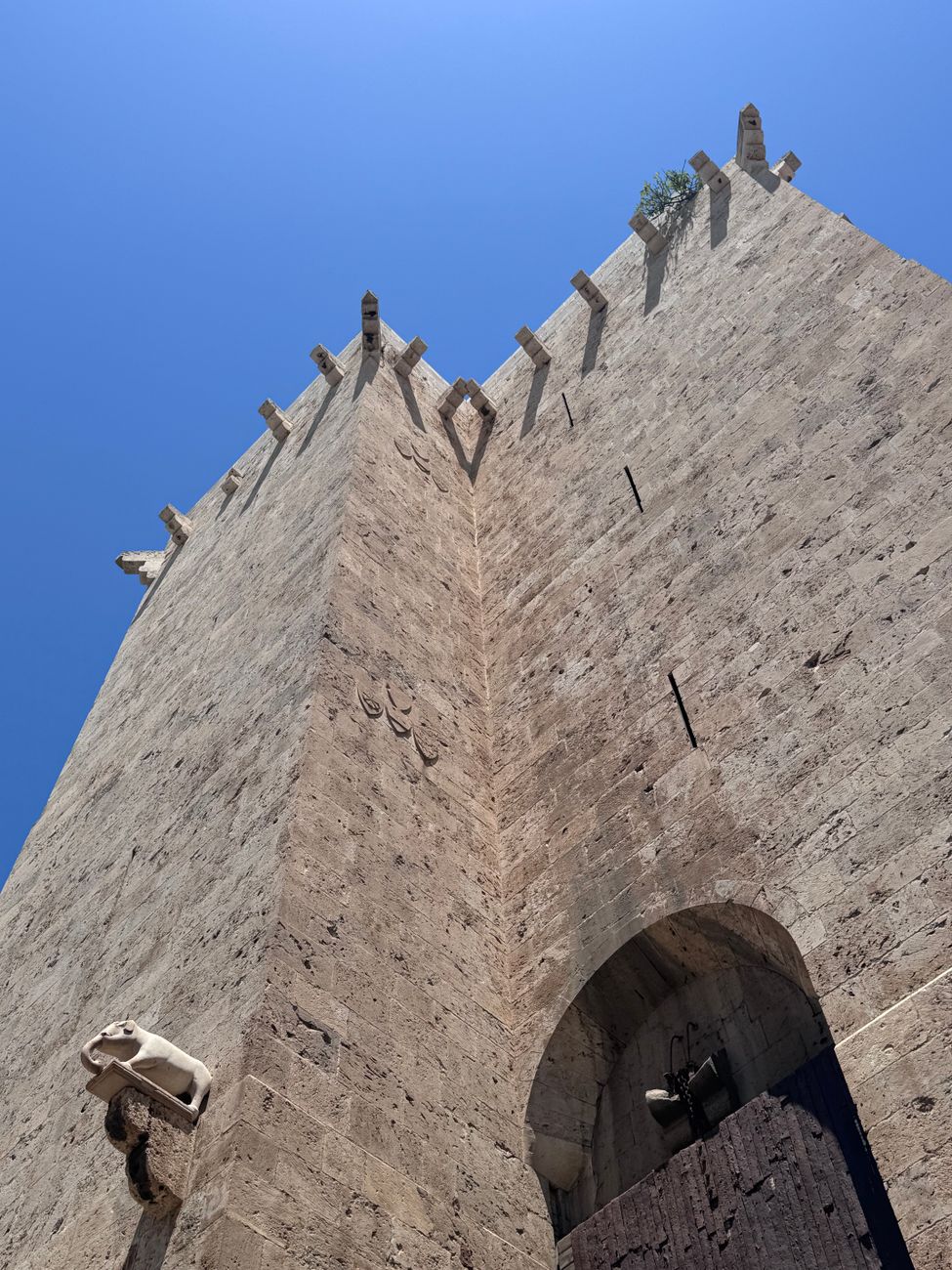
Today, Castello is a neighbourhood rather than a single castle. Much of its perimeter is still enclosed by walls, and historic gates connect it with districts below. Look at the fortifications first, then at what was built inside them: the contrast makes the hill's history much easier to read.
Why was Castello built on the hill?
The district stands about 100 metres above sea level, in a commanding position on limestone. Its Sardinian name, Casteddu de Susu, means the upper castle; the Italian Castello Superiore carries the same idea. Height is central to understanding the place: the district's fortified edge separates the upper streets from the lower city, while its terraces open towards the surrounding landscape.
Sources: Castello's hilltop setting and names
The Pisans founded and fortified Castello in the 13th century. According to Cagliari's municipal tourism account, they moved the seats of civil, military and religious power there from Santa Igia, the capital of the Giudicato of Càlari, which they had previously destroyed. A giudicato was a Sardinian polity; its loss and the transfer of authority are part of the story behind the new fortified centre.
This was more than a defensive enclosure. It brought the places where authority was exercised together on the hill. The walls defined a district that would continue to house important institutions and noble residences under successive rulers, long after its Pisan foundation.
The walls: a boundary around a neighbourhood
The surviving walls still surround much of Castello's perimeter. Rather than imagining one building called the castle, think of a fortified urban district: streets, squares, residences and churches sit within an edge marked by walls and towers. The boundary helps explain why approaching Castello can feel different from moving between streets in the lower city.
Sources: Castello's walls and medieval gates
Gates are the useful detail here. They turn the wall from an abstract line into a place of passage, connecting Castello to neighbouring districts. The medieval entrances are also reminders that a fortified centre still depended on routes to the city outside it. Their presence makes the walls part of the geography of a visit, not simply a backdrop for photographs.
Three towers and the entrances they help explain
The Elephant Tower and the Tower of San Pancrazio are the two towers specifically named in the municipal description of the walls around Castello. They give visitors prominent points of reference for the fortified perimeter. The Elephant Tower also has a gateway providing access to the district from Stampace, another of Cagliari's historic neighbourhoods.
Sources: Elephant and San Pancrazio towers
The Tower of the Eagle tells a slightly different story. Dating from the beginning of the 14th century, it is now incorporated into Palazzo Boyl. The Arcade of the Graces beneath it remains a southern access to Castello from Marina. Here, a medieval tower is part of both a later palace and a continuing connection between districts.
Sources: Tower of the Eagle and Palazzo Boyl
For an illuminating comparison, consider the Elephant Tower as a landmark at an entrance from Stampace, San Pancrazio as another major feature of the fortified circuit, and the Tower of the Eagle as a structure absorbed into a palace at the Marina-side approach. The three need not be treated as interchangeable: their settings show different ways the historic defences relate to the district today.
Saint Remy: a monumental connection to Villanova
The Bastion of Saint Remy is another place to see how the edge of Castello relates to the city below. Its monumental staircase directly connects Castello with Villanova, while the bastion incorporates the older Bastions of the Mint and Saint Caterina. The name Villanova refers to the lower historic district, not another part of the fortification.
Sources: Saint Remy and the older bastions
Saint Remy is useful to read alongside the tower gateways. At one point the transition is framed by a tower and arcade; at another it is expressed through a grand staircase and bastion. Both make the change in level and the relationship between the upper and lower districts visible, though they are distinct structures with different histories.
From Pisan stronghold to a centre under successive rulers
Castello's history did not stop with its founders. The municipal account places the Pisan period in the 13th–14th centuries, the Aragonese-Spanish period in the 14th–18th centuries and the Piedmontese period in the 18th–19th centuries. Across these changes, and into the period after the Second World War, the district continued to contain seats of power and noble homes.
Sources: Castello under successive rulers
The fortifications therefore frame a much longer story than the moment they were first built. They enclose buildings from different periods and uses, rather than preserving an unchanged medieval scene. The city's municipal account notes how closely Castello came to be identified with Cagliari itself: the city is called Casteddu in Sardinian.
This distinction helps when looking at an individual landmark. A tower may point towards the early fortified district, while a palace, church façade or university building can point towards a later chapter. They belong to the same neighbourhood, but not necessarily to the same building campaign or political period.
Palazzo Square: the power inside the walls
Piazza Palazzo, or Palazzo Square, is a good place to connect the defensive setting with the district's institutional role. The Royal Palace stands here, as does Cagliari Cathedral, the seat of the archdiocese and Castello's parish church. The square brings civil and religious authority into the same compact setting.
Sources: Royal Palace and cathedral
The cathedral itself offers a visible example of different periods within one landmark: the municipal description identifies its façade as neo-Romanesque and its bell tower as 13th-century. The Royal Palace also remains associated with public institutions, including the Prefecture and the Metropolitan City's council chamber.
Other historic buildings add to the picture, including the former City Palace, the Archiepiscopal Palace and the University Palace. The university's rectorate is housed in an 18th-century building in Castello. These are reasons to look beyond the walls: the district's importance also lies in the institutions and residences they enclosed.
The former arsenal and the museum district
The Cittadella dei Musei, or Citadel of Museums, adds another layer to the story. The modern complex was built on the site of the former Royal Arsenal. It includes the National Archaeological Museum, whose collections range across ancient Sardinian cultures, including Nuragic bronzes and material from Phoenician, Punic and Roman periods.
Sources: Citadel of Museums and former Royal Arsenal · National Archaeological Museum collections
Those collections are not a history of Castello's medieval walls. They offer a broader view of the island's past from a museum complex occupying a former military site. For a visit focused on what the collections contain, use the National Archaeological Museum guide rather than expecting the museum to explain every feature of the fortifications.
How to use this history on a visit
Start with the relationship between the hill and its neighbours: an entrance from Stampace, the southern approach from Marina, and the Saint Remy connection with Villanova each reveal a different edge of Castello. Once inside the district, compare those defensive structures with Piazza Palazzo and the buildings of civic and religious authority.
The Castello walking route provides a practical sequence of stops if you want to turn those ideas into a walk. This history guide does not promise access inside the towers or other individual buildings; check current arrangements separately if an interior visit matters to you.
If you are considering staying in the district, the same hilltop setting has a practical side as well as a historical one. The guide to staying in Castello looks at the approach and daily movement, leaving this article to focus on what the walls and landmarks mean.
Frequently asked questions
Is Castello in Cagliari a single castle?
No. Castello is a historic hilltop district, founded and fortified by the Pisans in the 13th century. Its walls enclose streets, squares, churches and historic buildings, while towers and gates mark parts of its perimeter.
Which towers are associated with Castello's walls?
The Elephant Tower and San Pancrazio are named as part of the fortified perimeter. The Tower of the Eagle is another historic tower: it is incorporated into Palazzo Boyl and marks an access from the Marina side.
Why are the cathedral and Royal Palace important to Castello's history?
They illustrate the district's role as a centre of religious and civil authority. Both stand in Piazza Palazzo, inside the fortified neighbourhood.
Is the Bastion of Saint Remy the same as a medieval tower gate?
No. Saint Remy is a bastion with a monumental staircase connecting Castello and Villanova; it incorporates older bastions. The tower gateways are different structures, connected with other approaches to the district.